
One block, laid by hand, no mortar.
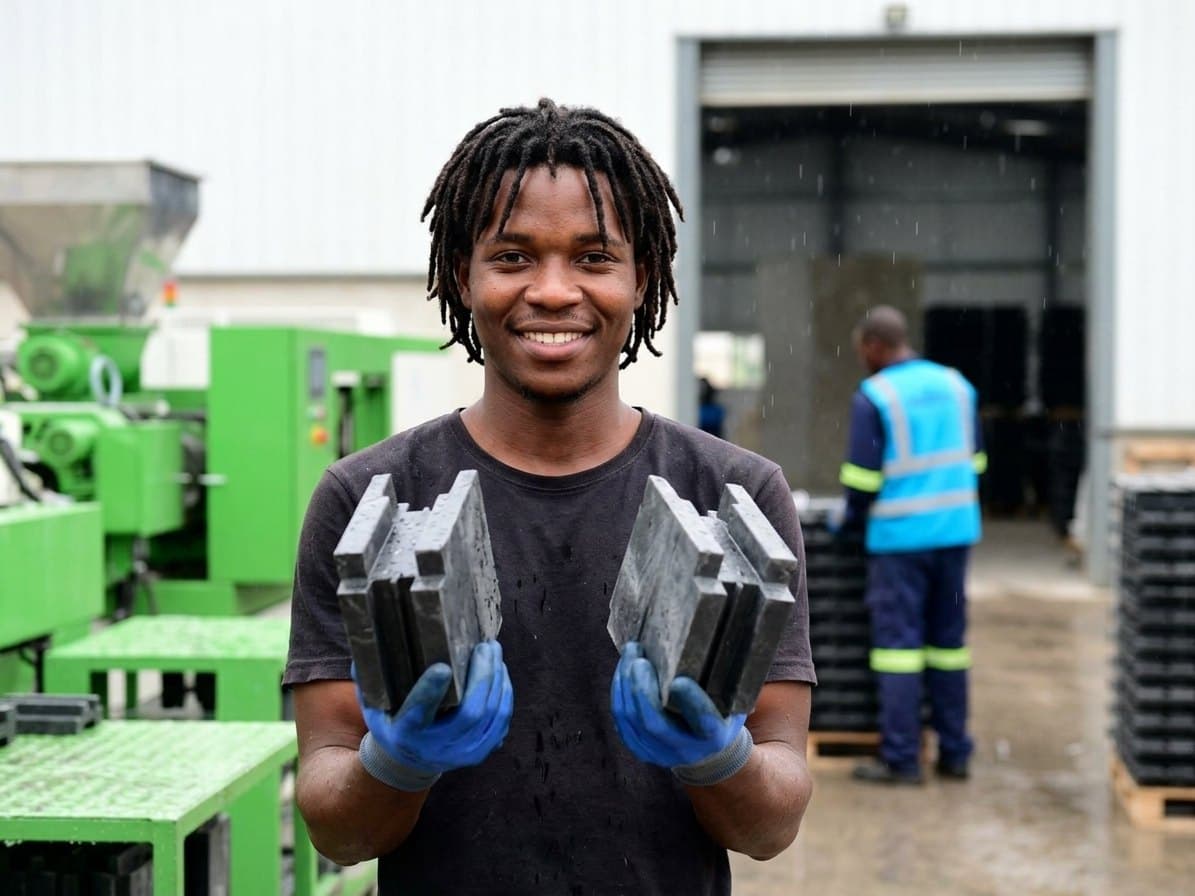
Household and industrial plastic waste is collected across Ibadan, washed, dried, shredded and blended to a controlled recipe, then extruded and pressed into an interlocking block. The blocks stack in running bond and lock together, so a wall goes up without a mason and without a bag of cement.
Stronger, drier, cooler, and it will not burn
Strength, design life and fire figures are the design values for our block system, drawn from the material and from comparable systems already in service elsewhere in Africa. Certified test data will be published on completion of product certification with the Standards Organisation of Nigeria.
Six to eight times stronger than a cement block
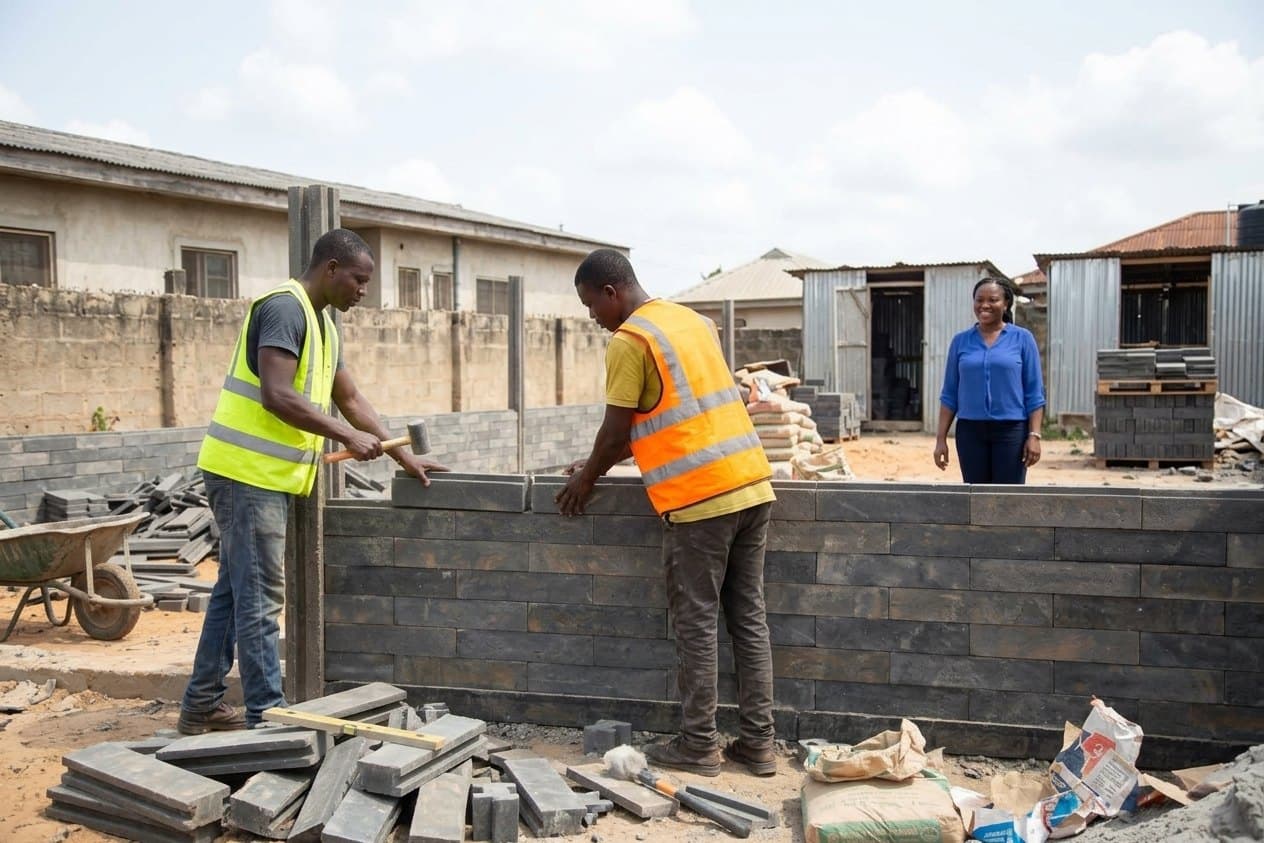
A wall built from our blocks is not a lighter compromise on a sandcrete wall. It carries six to eight times the compressive load of the block it replaces, which is why the system can go up to two storeys without a masonry frame.
Designed to stand for 400 to 800 years
Plastic does not absorb water. It cannot rot, it cannot spall, damp cannot creep up it and termites cannot eat it. A sandcrete wall in Nigerian humidity and heat begins to lose face within decades. Ours is designed in centuries.
It will not carry fire through the house
Three things keep the wall safe. A flame retardant package is compounded into every block, raising the temperature at which the material will ignite at all. The blocks are solid through, with no cavity and no air gap for a fire to travel along. And the material self extinguishes once the flame source is taken away, so a fire that starts in one room does not walk into the next.
Cool inside on a Nigerian afternoon
Plastic passes heat far more slowly than concrete or sandcrete, so the wall takes hours longer to move the afternoon sun into the room. There are no mortar joints, and mortar joints are where a masonry wall leaks heat. The blend is thermo acoustic, so it damps sound as it damps heat. Rooms stay cooler for longer, fans and air conditioners run less, and the electricity bill falls, which matters in a country where power is both expensive and unreliable.
Lighter to carry, faster to build, no mason needed
A block weighs a kilogram. One person can move a wall’s worth in a morning, which matters on sites a lorry cannot reach.
Dry stacked and self aligning, the blocks lock together by hand. A trained local crew can raise a wall without a bag of cement on site, and the walls for a two bedroom home go up in about three days.
What is in the block
Every figure below is a design value until certification completes. We do not round a number up to make it sound better.
From a sachet on the street to a wall that stands
Seven stages, one direction. Waste enters at the reception gate and leaves as palletised blocks. The stage most people skip is the one that decides whether the plant works.
Collection and sorting
Our own fleet and a network of independent collectors bring plastic in by weight. It is weighed, paid for, then separated by resin across sixteen picking stations.
Washing and drying
Soil, food residue, labels and adhesive come off in a hot caustic wash. Then the flake is dried below half a percent moisture. Water left in the flake turns to steam inside the extruder and produces a block that fails testing, which is why most plants of this kind fail.
Shredding and granulating
Two stages of size reduction bring everything to a uniform flake of eight to twelve millimetres.
Blending and dosing
A gravimetric blender holds the recipe to within one percent and doses the flame retardant, UV stabiliser and colour.
Extrusion
Four single screw extruders melt, filter and deliver the blend under controlled pressure and temperature.
Moulding and pressing
Hardened steel moulds form the interlocking geometry under a hundred and fifty tonnes of pressure, then hold it to temperature while it sets.
Cooling, testing and despatch
Twenty minutes of controlled cooling, a dimensional check on every cycle, and strength testing on samples from every shift before a pallet leaves the yard.
Every block starts as waste picked off the streets of Ibadan
Sorted plastic arrives baled and by weight. Each block consumes 1.25 kg of it. Eleven thousand blocks build a two bedroom house with two bathrooms; five thousand build a classroom.
Sell us your plastic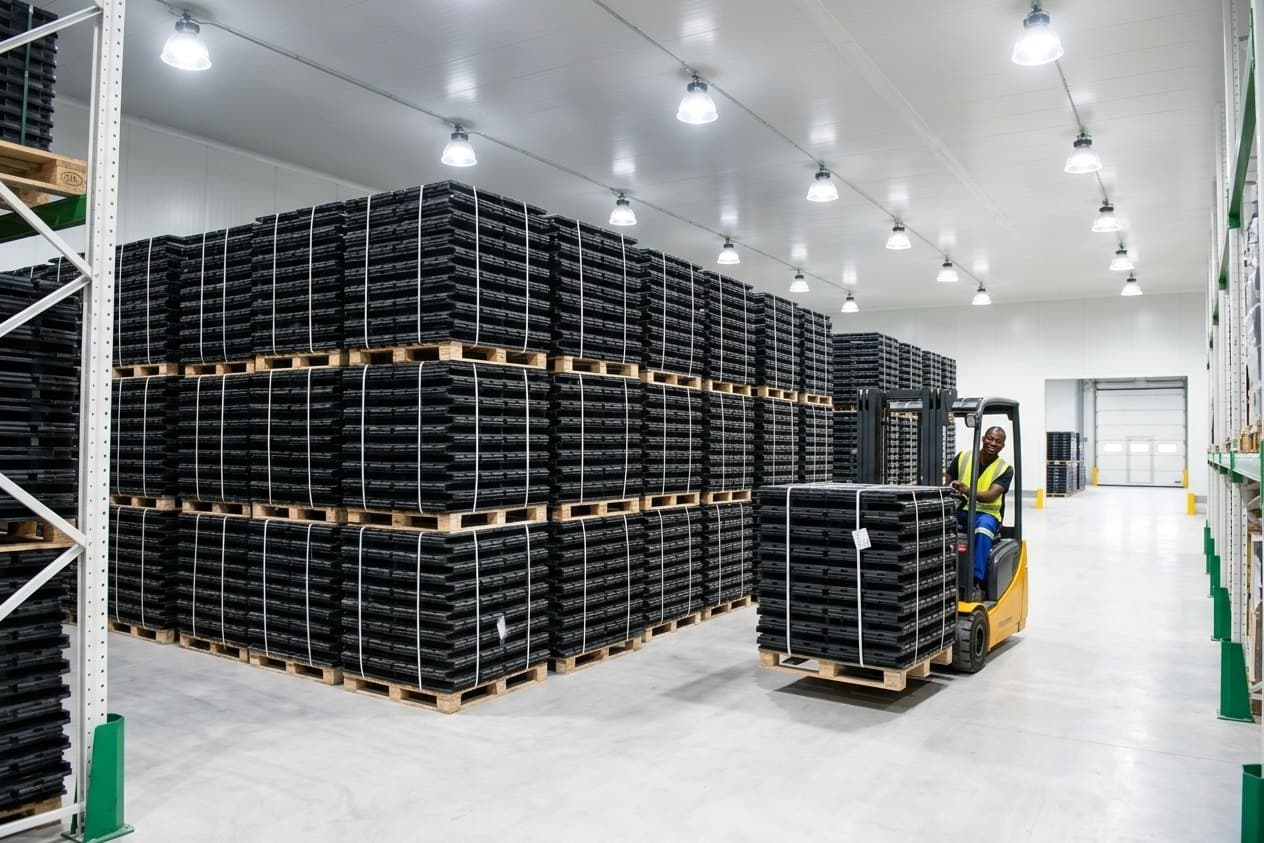
A block nobody can certify is not a building material.
It is not enough for the block to be strong. Somebody has to be able to prove it, in a laboratory, to a building control officer, on a Tuesday afternoon.
Tested before it leaves the plant
Melt flow index on incoming polymer, moisture every two hours, a dimensional check on every mould cycle, compression testing on samples from every shift, and flexural testing daily. Results are logged and traceable to the pallet.
Standards Organisation of Nigeria
We are pursuing product certification with the Standards Organisation of Nigeria, and where no Nigerian Industrial Standard yet exists for structural blocks made from recycled plastic, we intend to sponsor its development rather than wait for one.
Signed by registered engineers
Structural design and certification is signed by engineers registered with the Council for the Regulation of Engineering in Nigeria.
Sold by the pallet, delivered anywhere in Nigeria.
Blocks are sold on their own to developers, cooperatives, contractors and state housing schemes.